
Why Stretching Is Important: What It Really Does for Your Body and Performance
Wondering why stretching is important? Here’s what it actually does inside your body, and why it matters for your health and performance.
Most of us were told at some point that we “need to stretch more.”
We try it. It helps. Then we stop, at least until something feels tight or sore again.
The problem isn’t motivation.
It’s misunderstanding.
Stretching isn’t just about muscles.
It’s about fascia, the nervous system, and blood flow.
Understanding that changes everything.
What Stretching Really Is
We often think stretching makes muscles “longer.”
That’s not quite accurate.
At the smallest level, muscle fibres contain actin and myosin — tissues that slide together during contraction. But those fibres are bundled together and wrapped in fascia.
Fascia is the connective tissue that links everything in the body. It forms continuous chains from head to toe — more like a 3D web than separate pieces of muscle.
If you’re new to that concept, read How Everything Is Connected: A Look at Fascia.
When a muscle contracts, it’s not just shortening muscle fibres.
It’s tensioning a fascial chain.
So stretching is not just “pulling a muscle.”
It’s influencing the fascial system that connects the entire body.
This is why certain yoga poses can be so effective — they work along these fascial lines rather than isolating one muscle.
The Missing Piece: Your Nervous System
Here’s where most stretching advice falls short.
Your brain stem controls the autonomic nervous system — the systems you don’t consciously think about, like breathing, digestion, and heart rate.
If your nervous system is in a heightened state (stress, racing thoughts, tension), your tissues will stay in a contracted pattern.
You cannot force a relaxed stretch in a contracted nervous system.
This is why breathing and mindfulness matter.
They aren’t optional extras — they’re essential.
For a deeper explanation, see How Breath Impacts Posture.
If the nervous system doesn’t feel safe, the tissue won’t release.
Muscle Pairings and Why Forcing a Stretch Doesn’t Work
The body works in balanced pairs.
For example:
- The psoas and glute work together during walking.
- When the glute activates to move the leg back, the psoas lengthens.
- Then the elastic recoil of the psoas helps bring the leg forward.
Their nerves communicate constantly.
If the psoas is overly active (common in stressed or desk-based clients), it can neurologically inhibit the glute. The body does this to prevent overload or injury (and this pattern is one of the common posture issues).
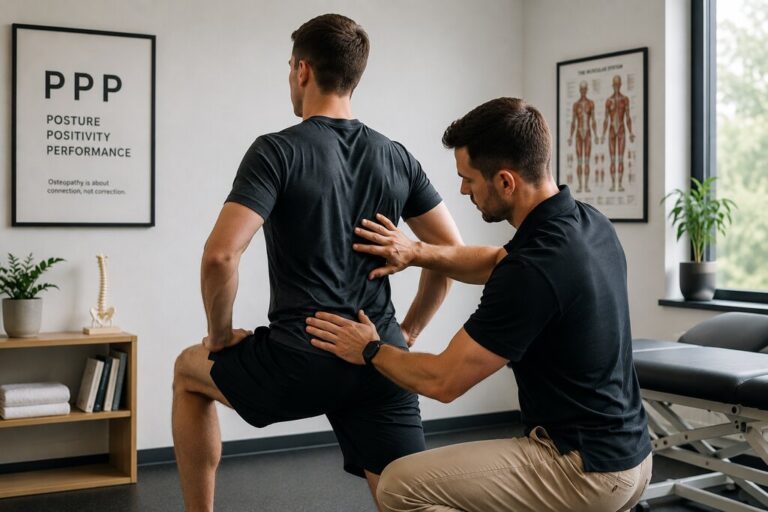
So if you try to stretch the psoas by simply leaning back and pulling on it, the nervous system may resist.
A better approach?
Activate the glute first.
Create neurological balance.
Then stretch.
The body releases what feels safe to release.
Why Aggressive Stretching Can Backfire
Pulling hard on tissue can compress the structures running through it — nerves and blood vessels.
If those structures are compressed:
- The brain senses threat
- Muscles guard
- Blood flow decreases
- Recovery slows
This connects directly to an osteopathic principle: The role of the artery is absolute.
Healthy tissue needs circulation.
If stretching restricts blood flow instead of improving it, performance and recovery suffer.
The Most Important Element of Stretching: Breathing
Breathing is the key.
Deep diaphragmatic breathing helps calm the nervous system, improve circulation, and create internal pressure that supports proper spinal alignment. But it does more than relax you mentally — it expands tissue from the inside.
A full breath gently opens neurovascular spaces, allowing blood flow to improve and tissue to soften. As the nervous system settles, fascia becomes more responsive and the stretch becomes more effective.
This idea is central to The PPP Theory, where posture, positivity, and performance are all influenced by breath.
Without proper breathing, stretching becomes mechanical and limited. With it, stretching becomes restorative.
A Smarter Way to Stretch
Next time you stretch, try this:
- Check your posture. Are you aligned?
- Activate the opposing muscle.
- Take a slow, full breath into the diaphragm.
- Exhale and gently move into the stretch.
- Stay relaxed — no forcing.
Stretching works best when posture, nervous system, and movement are working together.
That’s where performance improves — not just flexibility.
Want to read more? This is the same concept that is talked about in How Olympic Sport Shaped the PPP Framework, where breath, activation, and alignment drive performance.
FAQs About Stretching
Does stretching prevent injury?
Stretching supports circulation, nervous system regulation, and tissue balance. However, injury prevention depends on proper strength, alignment, and movement patterns — not flexibility alone.
Is static or dynamic stretching better?
Both have value.
Static stretching can help calm the nervous system and improve awareness of tension patterns. Dynamic stretching prepares tissue for movement and performance.
The key is how and when you use each one.
Why do I feel tight even if I stretch regularly?
Tightness is often neurological, not muscular.
If stress, posture, or breathing patterns remain unchanged, the nervous system will continue to hold tension — even if you stretch daily.
Should stretching hurt?
No.
Mild tension is normal. Sharp pain or aggressive pulling usually triggers protective guarding, which limits effectiveness and recovery.
How long should I hold a stretch?
Long enough to breathe and relax into it.
If your breath is shallow or you’re bracing, you’re not actually releasing the tissue.
Final Thoughts
Stretching is not about forcing range.
It’s about fascial balance, nervous system regulation, blood flow, and breath. When those systems are working together, flexibility improves naturally — not because you’re pulling harder, but because your body feels safe enough to release.
If stretching has never seemed to “work” for you, it may not be a flexibility issue at all. It may be posture, breath, or nervous system tension driving the pattern.
Understanding that shift is where real change begins.