How Olympic Sport Shaped the PPP Framework
As the Winter Olympics unfold, I find myself thinking back to the summer of 1984.
I was five years old, watching swimming at the Los Angeles Olympics — probably my first real memory of sitting in front of a television. I didn’t understand race strategy or split times. I just knew I wanted to move like that. Fast. Smooth. Effortless.
That summer at Sunnyvale campground, I tried to recreate what I had seen. Arms flailing. Legs kicking. Water everywhere. The only thing moving quickly was the water up my nose.
But something had started.
Over the next twelve years, swimming became more than a sport. It became an Olympic dream. There were provincial teams, shoulder injuries, fast swims and frustrating plateaus. Like most athletes, I believed that working harder was the answer.
It took years — as a swimmer, a coach, and eventually an osteopath — to realize that elite performance isn’t built on effort alone.
It’s built on posture.
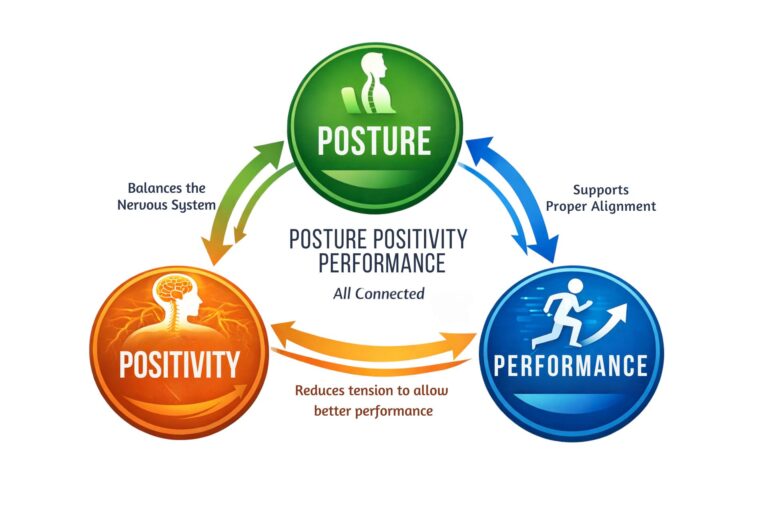
And that realization became the foundation for what I now call Posture, Positivity, and Performance.
Performance Isn’t About Trying Harder
Like most young athletes, I believed progress came from effort. More laps. More time in the pool. More grit.
And for a while, that worked.
But over time, injuries showed up. My right shoulder began to limit what I could do. Times plateaued. Frustration crept in. What I didn’t understand then was that pushing harder wasn’t solving the problem.
I wasn’t lacking effort.
I was lacking an understanding of what actually drives performance.
When my Olympic dream in the pool began to shift, I found myself drawn to the science behind performance. I studied kinesiology. I trained in massage therapy. And through that training, I was introduced to something that changed how I understood movement altogether — fascia.
Fascia isn’t just connective tissue. It’s the system that allows force to transfer through the body. It links shoulders to hips, hips to spine, spine to breath. When it’s organized, movement feels efficient. When it’s not, effort leaks.
As I began coaching swimmers while building my clinical practice, I started to see the same pattern repeatedly:
When posture improved, stroke mechanics improved.
When alignment changed, power changed.
When breath stabilized, performance stabilized.
It wasn’t about pushing athletes harder.
It was about correcting their foundations, using posture to support movement, positivity to create neuromuscular control of that movement and breathe, and performance as the outcome.
On the pool deck, long before it became a framework, the Posture Positivity Performance (PPP) principles were already taking shape.
Olympic-Level Exposure
Over the next several years, my work moved beyond local swim meets and into national and international high-performance environments. From Olympic Trials in Montreal to the Junior Pan Pacific Championships, I had the opportunity to observe how elite systems prepare athletes for the highest level.
I had the opportunity to work with athletes preparing for Olympic Trials, to serve as a therapist within the Canadian high-performance system, and to observe some of the top swimming nations in the world.
What stood out wasn’t intensity.
Every program worked hard.
What stood out was how much attention was paid to foundational and fundamental skills.
The best athletes weren’t simply stronger, they had a foundation that supported their strength. Their posture under load didn’t collapse. Their breathing didn’t spiral under pressure. Their mechanics didn’t unravel late in races.
They could access their strength because their structure supported it.
I remember spending hours in treatment areas during national and international competitions, watching activation routines, warm-up patterns, and recovery protocols. Different countries had different systems, but the common thread was clear:
Alignment first.
Connection second.
Performance third.
The more exposure I had to high performance sport, the more it reinforced what I had already begun seeing on the pool deck.
Posture was not cosmetic.
It was the foundation of performance.
From Creating Olympians to Creating Olympic-Level People
For years, my focus was on creating performance at the highest level.
Train. Improve. Qualify. Compete. Repeat.
But when I stepped into grassroots development, one issue became obvious: athletes were trying to perform without foundational control.
They wanted speed without posture.
Power without alignment.
Intensity without connection and self-regulation.
That approach works — until it doesn’t.
Injuries increase. Mechanics break down. Performance becomes inconsistent.
High-level sport doesn’t reward effort alone. It rewards structure.
If posture collapses, force leaks.
If breathing destabilizes, power drops.
If connection and self-regulation fails, performance suffers.
The solution isn’t more intensity.
It’s better foundations.
That’s where the framework began to formalize — not as theory, but as a training principle:
Posture first.
Connection second.
Performance third.
Performance is not the starting point.
It is the result.
The PPP Principles
Posture, Positivity, and Performance are not separate ideas. They are sequential and interdependent.
Posture
Posture is not about standing up straight.
It’s about structural alignment that allows force to transfer efficiently through the body.
In sport, posture determines how power moves from the ground, through the hips and spine, into the limbs. When posture is compromised, strength cannot be fully accessed.
In daily life, the same principle applies. Whether you’re swimming, running, sitting at a desk, or lifting a child, your structure determines your efficiency.
Posture is the foundation.
Positivity
Positivity is not mindset coaching or forced optimism.
It is nervous system regulation.
In high-performance environments, the athlete who can self-regulate breath and composure under pressure can access more of their skills and strengths.
When the nervous system is dysregulated, posture changes. Breathing changes. Mechanics change.
Self-regulation supports structure.
Performance
Performance is the visible outcome.
Speed. Strength. Consistency. Output.
But performance cannot be separated from posture and regulation. It is built on them.
When structure is sound and the nervous system is regulated, performance becomes repeatable.
Bringing It Together
Elite athletes at the highest level understand this — whether they use the language of fascia, posture, or regulation.
They train foundations.
The same principles apply outside of Olympic sport.
Young athletes. Desk workers. Recreational runners. Swimmers. Coaches.
The PPP framework exists to make those high-performance principles accessible to everyone.
Making Olympic-Level People, Not Just Athletes: Everyday Applications
As we watch athletes compete on the Olympic stage, what we’re really witnessing is the refinement of foundations.
Years of developing posture under load.
Years of training breath under pressure.
Years of building performance on structure and self-regulation.
The spotlight highlights the result.
It rarely shows the foundation.
The Posture, Positivity, and Performance principles were not developed as abstract theory. They were shaped in high-performance environments, tested on pool decks, refined in treatment rooms, and applied across various levels of sport.
But the principles are not reserved for elite athletes.
They apply to youth development programs. To recreational athletes. To coaches. To weekend warriors. To professionals who want to move and perform without chronic breakdown.
Performance begins with posture.
Consistency depends on self-regulation.
Results follow foundations.
If you’re interested in learning how the PPP principles can support your athletes, your organization, or your own performance, I welcome the conversation.