The PPP Theory: How Posture, Positivity, and Performance Work Together
You’re doing all the right things. Stretching. Strengthening. Fixing your technique. But something still feels off — like your body’s stuck in a loop it can’t break out of.
Pain returns. Posture collapses. Performance dips. And no matter how much effort you put in, it never quite clicks.
Over time, I started to notice a pattern — not just in athletes I worked with, but in almost everyone dealing with persistent tension, pain, or movement issues.
The problem wasn’t isolated. It wasn’t just in the shoulder, or the back, or the breath. It was in the way those systems interacted.
That’s what led me to the PPP Theory — a way to understand how Posture, Positivity, and Performance work together.
When one of them shifts, the others respond. And when they align? That’s when things finally start to change.
What Is the PPP Theory?
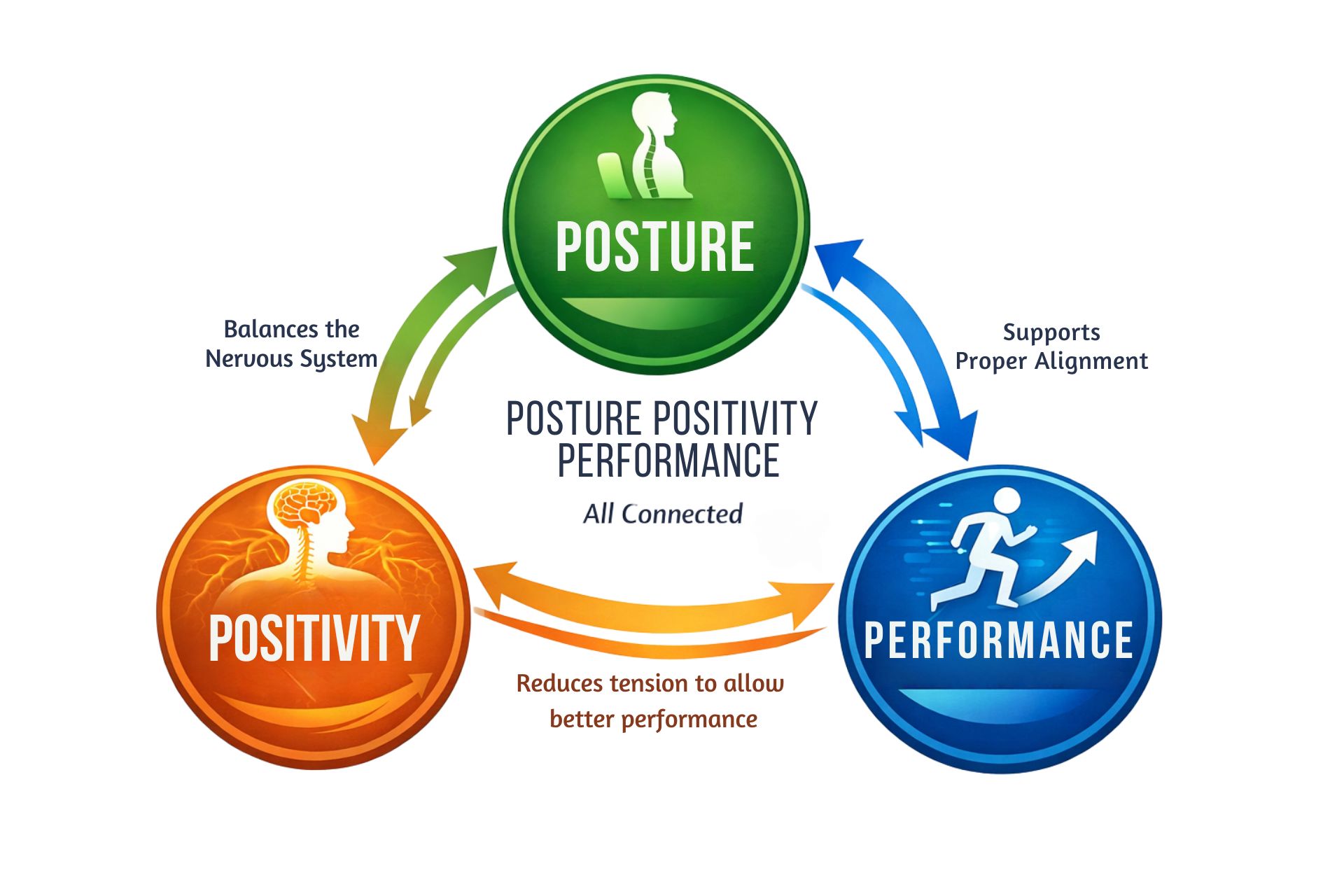
PPP stands for Posture, Positivity, and Performance.
Each one reflects a layer of how your body and nervous system interact:
- Posture is more than just standing tall. It’s how your body organizes itself as you move, breathe, and respond to stress — including gravity and your sense of safety.
- Positivity isn’t about forcing a positive mindset.. It’s about your nervous system’s state. Are you in a place of safety and openness, or are you constantly on guard?
- Performance is the result of how your body functions as a whole — whether that’s swimming, lifting, parenting, or simply moving through your day without pain.
These three layers influence each other constantly. If one breaks down, your whole system compensates — and that’s when problems start.
Where the PPP Theory Was Born
I started noticing this connection between posture, nervous system state, and performance long before I had a name for it.
Back when I was coaching swimmers, shoulder pain was a constant issue. I began experimenting with activation drills before practice — things like scapular engagement, posterior chain priming, and breath awareness.
And something shifted. Posture improved. But more than that, they started to move with more confidence. Less hesitation. More presence in the water.
Later, while working with elite athletes, I refined this approach even further. On one particular athlete, I used posterior chain activation not just to support posture, but to change the way he moved. By shortening the posterior chain and opening up the anterior side, we reduced back pain, improved breathing mechanics, and helped him generate more power through his stroke.
Posture. Nervous system state. Performance. All connected.
One of the clearest examples of this connection came from observing the startle reflex. I’ve done this experiment with dozens of athletes. Startle someone — even gently — and you’ll see it immediately:
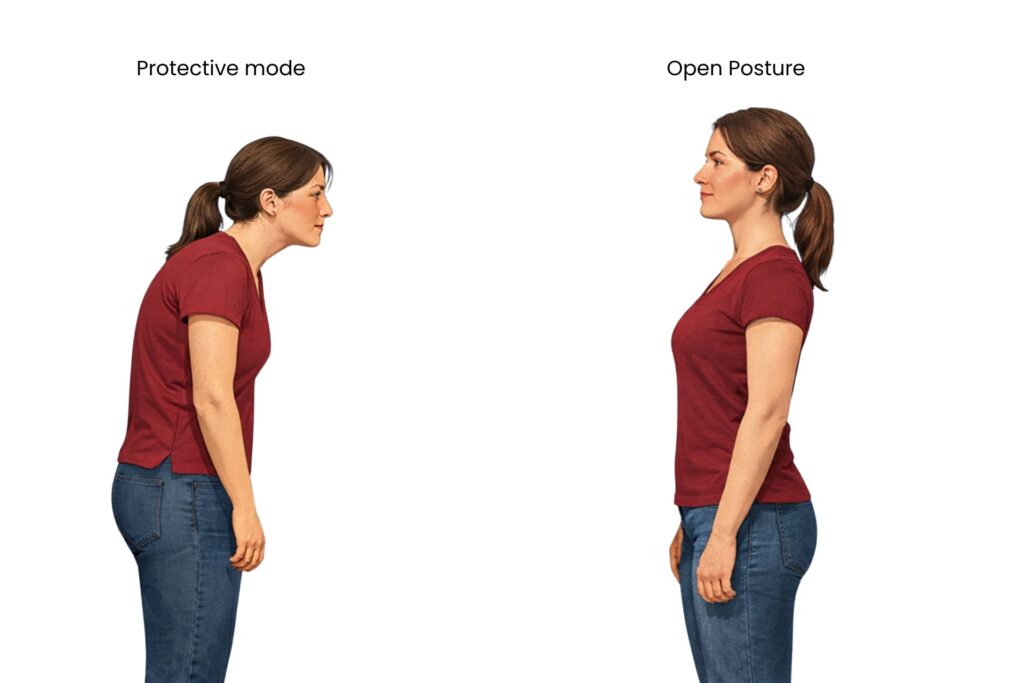
Shoulders round forward. Pelvis tucks under. Breath tightens. The body folds in — a protective response hardwired into the nervous system.
But here’s the key: if we can train the nervous system to stay open, even under pressure, posture changes. Breathing changes. And performance follows.
| 🧍♂️ Posture | 🧠 Positivity | 🏃♂️ Performance |
| Alignment & breath | Nervous system & mindset | How you move & respond |
Each pillar of the PPP Framework supports the others — posture, mindset, and movement are inseparable.
Why It Matters: Most Treatments Miss the Interconnection
Most approaches treat pain or performance as an isolated issue:
- Sore shoulder? Treat the shoulder.
- Poor form? Drill the movement.
- Anxious before competition? Try to calm down.
But the body doesn’t work in pieces.
Your posture affects your breath.
Your breath influences your nervous system.
And your nervous system controls how your body holds itself.
If you’re stuck in a protective “turtle mode” — pulled in, shoulders rounded, core collapsed, breath shallow — your body isn’t set up to move well.
It’s not focused on performance. It’s focused on protection.
That’s the problem most treatments miss: they target the symptom, without considering the state of the nervous system, or more importantly, the overall state of the person.he symptom, not the state.
When you start addressing the system as a whole — with posture, breath, and nervous system working together — that’s when things actually shift.
What This Looks Like in Practice
So how does this actually show up in the real world?
In a session, it might start with something as simple as noticing how someone walks into the room — how their shoulders are positioned, where their weight is, how they breathe when they speak.
I’ll look at posture, nervous system tone, and how the body might be holding or bracing — often without the person realizing it.
From there, treatment might focus on breathwork before mobility. Posture before strength. Or helping the nervous system downshift before asking the body to perform.
Because if your system is stuck in defense, pushing harder won’t solve the problem.
But if we create internal space — through breath, alignment, and awareness — your body starts to move from a place of readiness instead of reactivity, confidence instead of fear.
And in everyday life? That’s where the PPP framework becomes a powerful reset.
How to Use PPP in Real Life
You don’t need a full treatment plan to start shifting things.
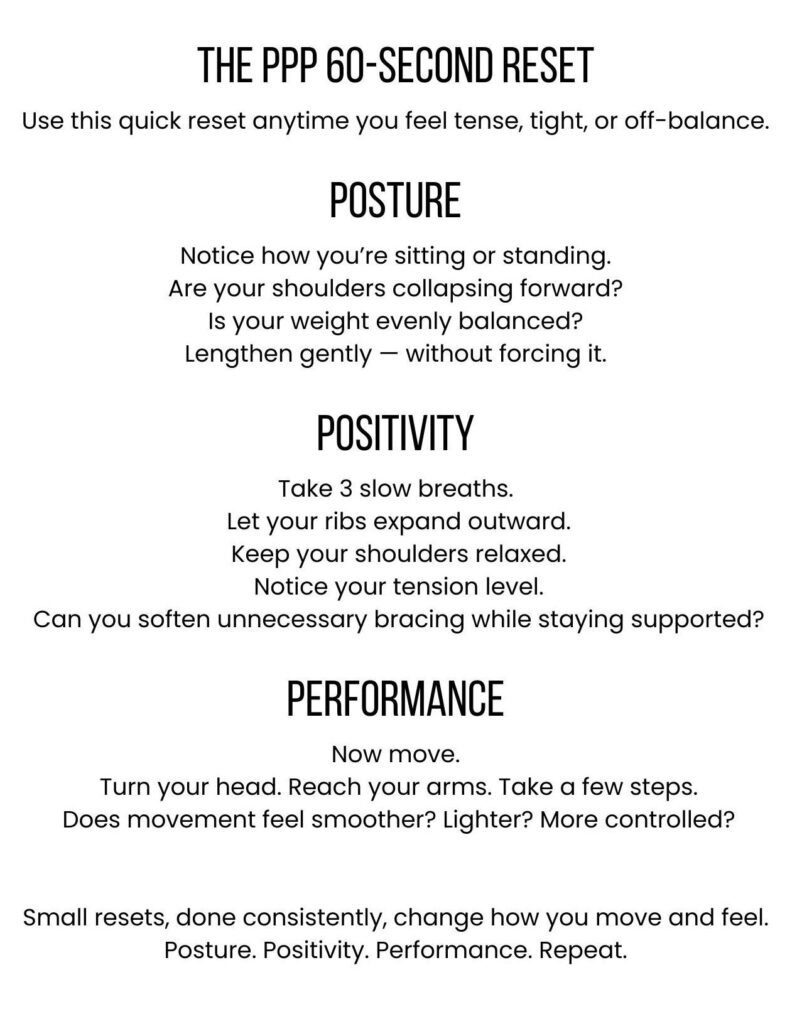
Here’s a simple daily check-in anyone can try:
- Posture: Notice how you’re sitting or standing. Are your shoulders collapsing? Is your weight balanced?
- Positivity: Take 3 slow breaths. Are you breathing up into your neck, or out into your ribs? How does your nervous system feel? Alert but grounded, or hyper-aware and braced?
- Performance: How does it feel to move now? Does it feel lighter or smoother?
These quick resets can shift your state in under a minute — and over time, retrain how you hold yourself under pressure.
They’re simple, but they reconnect your system, and that’s where change begins.
The Power of Perspective
I once worked with an athlete who told me about a race where everything went wrong — she fell apart, missed her marks, and felt like she’d failed.
But when I asked her to revisit that moment, something surprising happened: her body didn’t collapse.
She stayed upright. Balanced. Grounded.
She had already reframed the experience — not as failure, but as something she learned from. And that shift in perspective changed how her body held itself.
That’s PPP in action.
Mindset affecting posture. Nervous system shaping performance.
It’s All Connected
Posture. Positivity. Performance.
They’re not separate ideas — they’re parts of the same system.
When your body is aligned, your breath is open, and your nervous system feels safe, you move differently.
You respond instead of react. You perform instead of protect. And often, that’s the shift people have been chasing without knowing what was missing.
The PPP Theory isn’t just a model I work with — it’s something I’ve seen play out over and over again, in training, in recovery, and in everyday life.
Once you start noticing the connection between how you feel, how you stand, and how you move, it’s hard to unsee it.
And that’s when change really starts to happen.
Interested in learning more?
Here are a few next reads that explore how posture, breath, and mindset shape the way you move: